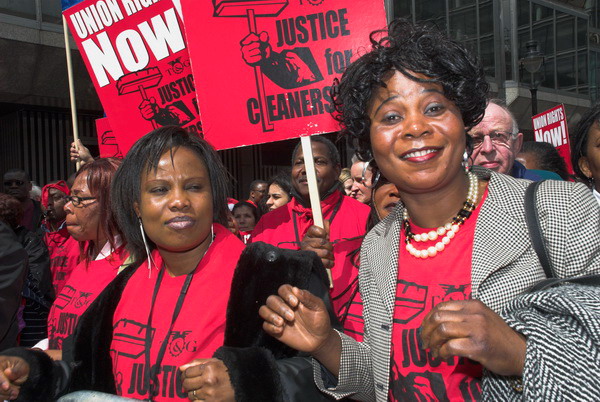
1 may saw the launch of the london citizens workers' association, a
new organisation to support low-wage and migrant workers across
london, backed by faith organisations, trade unions and social justice
organisations. may 1 was the feast of st joseph the worker
and the event began with a procession into the cathedral and a 'mass
for workers'. but i didn't bother to get up in time for that
after the mass was a 'living wage rally' outside the
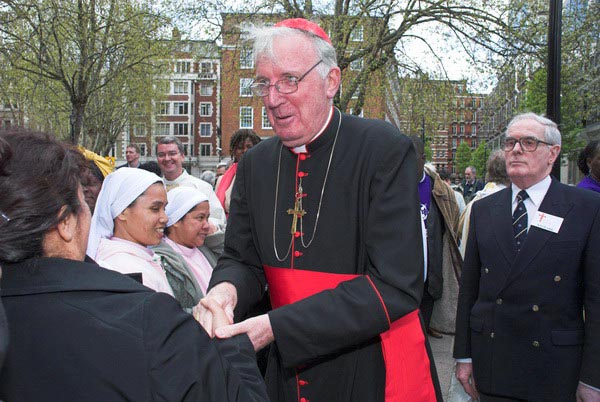
cathedral, with speakers including cardinal cormac murphy
o'connor (the leader of the catholic church in england &
wales), sir iqbal sacranie (secretary general, muslim
council of britain), and jack dromey (general secretary of
the tgwu) along with representatives of other unions and faiths, and
of the new association.
the workers association aims to fight a campaign for a living wage
for low paid workers as well as training them to organise and campaign
and providing free advice on rights at work and legal support. workers
in low paid jobs often also lack decent working conditions and there
is little trade union representation. it will also provide english
classes.
several large employers who have already taken steps to improve
conditions were awarded 'living wage employers awards' at the rally,
but i didn't wait around for this.
more pictures
around half of london's tube network seemed to be down for planned
engineering works, and getting around was a bit like playing
mornington crescent to some very special rules. but the victoria line
and thameslink got me to farringdon well before the start of the
annual may day parade.
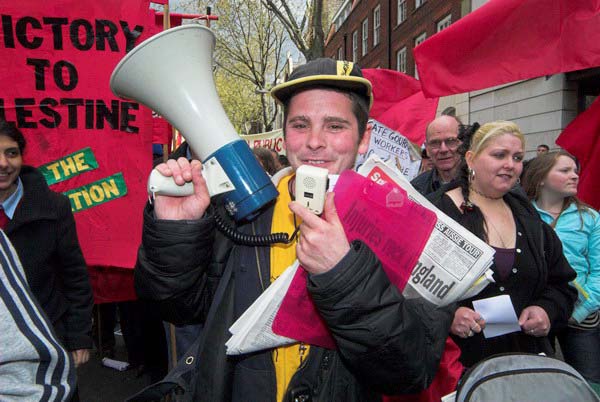
this seemed larger than in previous years, with a few more trade
unions ther. there was particularly strong support from the rmt, but
many others also took part, including my own (and there were many
members covering the event as well.)
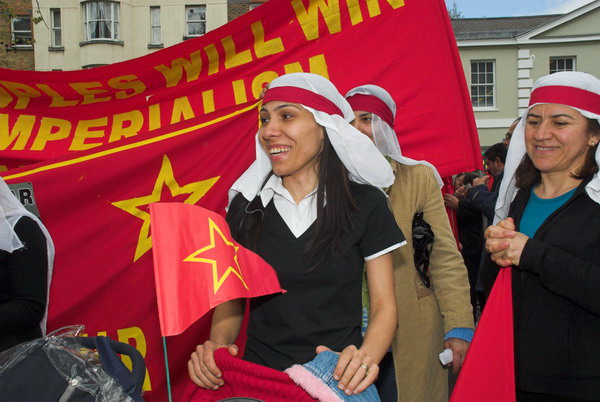
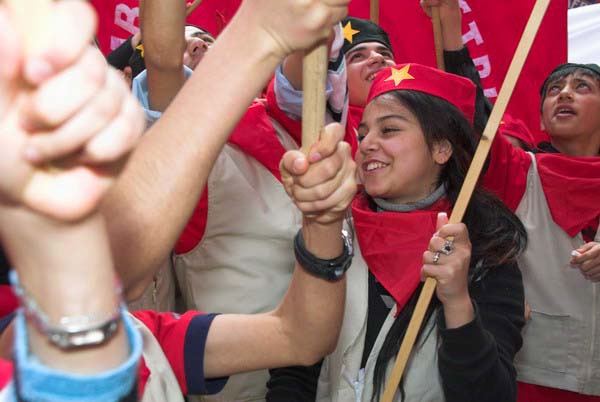
as usual, the most colourful aspect of the march was provided by the
various turkish communist parties, with strong youth wings. mklp (and
its kgo youth), the dhkc, the tikb, the tkp/ml and probably more.
there were some powerful reminders of the repression in turkey in the
portraits of some of those who have died in terrorist actions or death
fasts.
movements in a number of other countries were also represented,
including iraq, iran greece and sri lanka as well as the kurds. also
taking part was the african liberation support campaign network.
gate gourmet strikers marching behind their banner chanted "tony
woodley - out out!" denouncing the attempts of the tgwu to
force them to sign the compromise agreement which waives their rights
to further work or legal redress. others demanded that remploy
factories be kept open. There were protests over the dexion and samuel
jones pension outrages, and other causes.
more or less bringing up the rear of the march were around 500-1000
in the autonomous bloc, an anti-capitalist grouping marching against 'precarity',
the working environment of late capitalism.
increasingly there is a polarisation of the employment market in our
service-based economies, characterised at one end by poor conditions,
lack of job security, temporary employment, use of migrant labour at
one extreme, and, at the other by increasing encroachment of work into
the private lives of more highly paid employees, making them into
company property in exchange for their security.
in contrast to the relatively low-profile police presence for the
rest of the event, this bloc was flanked on both sides by a line of
uniformed police.
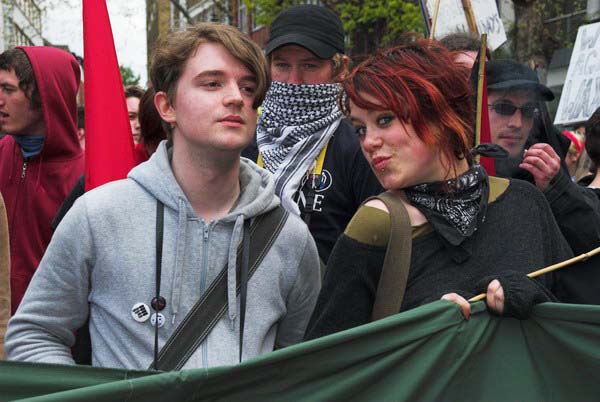
many of the marchers in this section wore scarves covering the lower
half of their faces, and some carried anarchist flags. leading the
block were a number of bicycles, and a pedal powered sound system.
the march continued on its way to trafalgar square, where people
stood around mainly looking pretty bored. i didn't catch much of the
speeches but if what i heard was typical i could understand why.
when the autonomous bloc arrived, the police barred their entry to
the square on the grounds of public order and seized the sound system.
more than half those marching left at this point, with the police
making little attempt to stop individuals who wandered into the
square.
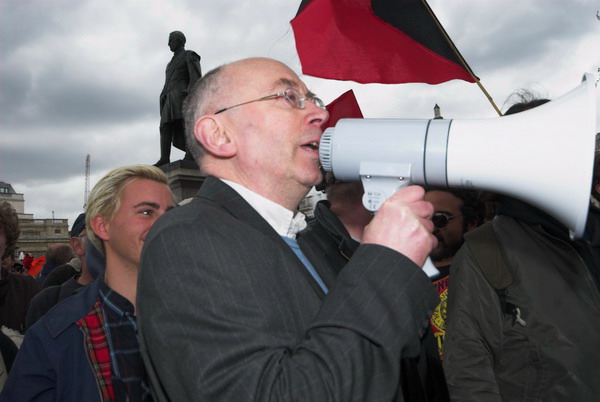
the rest of the bloc stayed on the road, with a few short speeches
over a loud hailer, then moved up the side of the square towards the
national gallery, where there was another short meeting. this was
interrupted by the news that the police tactical support group was on
its way, and they soon surrounded the relatively small group who had
decided to stay.
i walked through the police line at this point, and they seemed to be
making little attempt to stop anyone leaving, or at least didn't
detain them for more than a few minutes.
more pictures
while marchers were walking to trafalgar square, i took what was left
of the tube to bank and the 'police victory party' organised on their
behalf by the space hijackers.
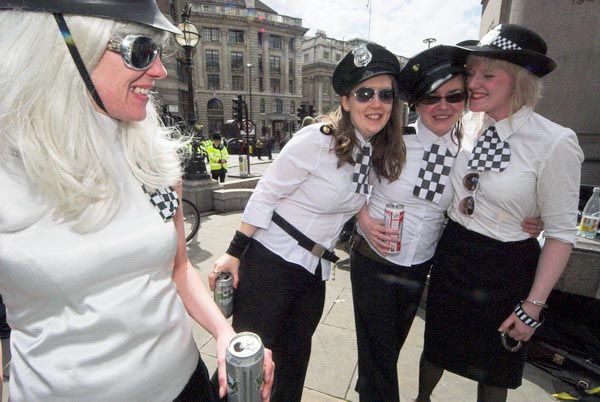
there i watched tony blair and some rather more attractive than usual
police (and with pink fluffy hand-cuffs) being watched by some other
police. a couple of these walked away when asked if they would mind
being photographed, but some others seemed to be rather amused by the
proceedings.
of course, the police (both lots) were taking lots of pictures of the
events too, and i can imagine some of them causing amusement at
section house parties.
there was a 'pin the blame on the anarchist' game, a pinata (ta for
the mini mars bar) and some dancing before i had to rush off to make
the gig at trafalgar square.
where the politics were perhaps less serious.
more pictures
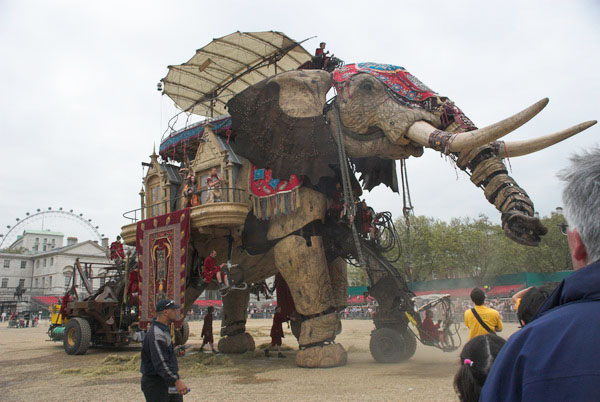
just why does it take so many people to drive an elephant when one
elephant can do it on its own was the main question that came to me
while watching the sultan's elephant in the centre of london.
after that, it did occur to me to ask why the arts council was
spending so much of our money on guys who wanted to play with big
toys. seems more or less a larger version of model railways to me, or
perhaps even more a simplistic version of a computer game fantasy made
manifiest - and of any significance as art. more disneyland.
it had the big advantage of closing large parts of the centre to
traffic, making it more pleasant to walk in than usual once you got
away from the jamboree. though i still bridle at the sight of crowd
barriers blocking off trafalgar square (especially when it meant i had
to walk a long way round to get to the loo.)
it was a little bit of public spectacle, and doubtless the kind of
thing that attracts tourists, but just not the direction i like seeing
arts council money thrown.
more pictures
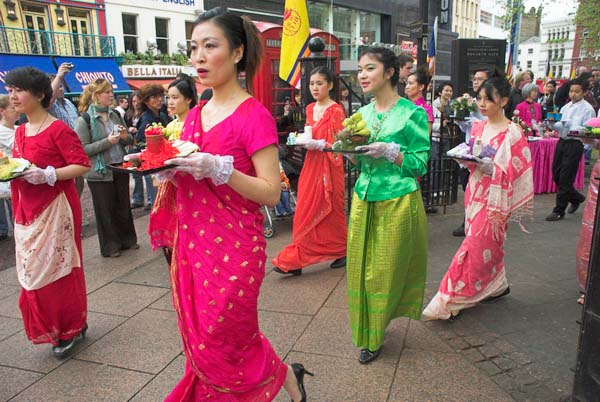
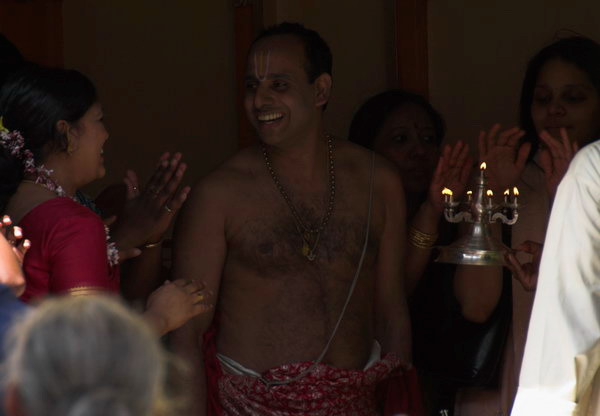
along in leicester square the celebrations of buddha's birthday were
going on. on almost every level many ways much more interesting than
the sultan and his crew, but fortunately attracting smaller crowds,
making it considerably easier to take pictures.
it was also a considerably more colourful event, and one that lifted
a window on one of london's communities. the festival continued over
two days, but i only stayed around an hour, leaving as the procession
left to travel around the area.
more pictures
may day celebrations were traditionally times (known as beltane) when
the new year and spring was celebrated, and young men and women danced
together, and a queen of the may was chosen to lead the event.
cromwell banned them as sinful pagan events, and although they came
back with the restoration in 1660, in most places the traditions
slowly died out or were made more formal.
there was a revival of interest in old customs in the victorian era,
with various 'merrie england' events being organised. some schools had
maypoles and learnt the dances and many sunday schools had their may
queens who often took a leading part in whit walks.
last year i photographed the hayes merrie england and london may
queen festival, which began in 1913 and is probably the largest as
well as the oldest continuing event of its type (brentham had its
"gaily dressed maidens" dancing around a maypole in 1906, but it isn't
clear if there were festivals in all of the early years. certainly
there appear to have been none in 1927-30.)
chislehurst got its first may queen in 1923, when the organisers of
the merrie england festival at hayes, which had been going for around
10 years, asked agnes everist to organise a new 'realm' with her
daughter olive as the may queen. agnes continued to organise the
ceremonies until 1945, when the ceremony was delayed until june to be
a part of the world war ii victory celebrations. her grand-daughter
and olive's daughter beryl was may queen that year, but sadly agnes
died 2 days later.
the everist family continued to organise the festival for some years,
but others then took over. any girl five or over who lives or has
grandparents who live in chislehurst can join the retinue. they then
work their way up the ranks, with the oldest girl of the year of
joining having the choice of being queen or prince. several months of
twice-weekly rehearsals are required, and as well as the festival they
also perform at other events.
the procession is led by a banner bearer, and each of the 'realms'
that takes part in the hayes festival is also identified by a
distinctive colour. the may queen and prince walk under a hoop garland
held by two of the retinue, others hold the queen's train. before the
crowning, the retiring queen and prince are at the head of the
procession, and the queen and prince elect in the middle, but after
the crowning they change their places. also in the procession are
three attendants carrying the basket of flowers, the crown on a
cushion and the sceptre and scroll. at the rear of the group is a
decorated cage or lantern on a pole.
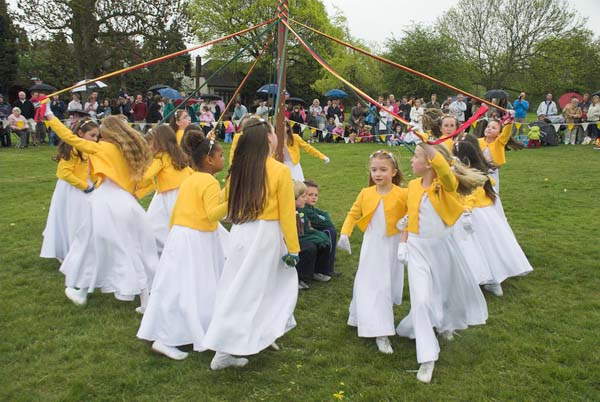
chislehurst is one of the few may queen societies that still dance
round the maypole properly, and they performed 4 different dances
during the event with surprising precision
at the end of the day the various groups marched off down the road
for tea and cakes in the methodist hall, along with a little more
ceremony. i stayed until they had cut the cake, then had to run to the
station to catch my train home.
more pictures
as it was almost exactly 61 years since the end of the second world
war, it seemed an appropriate day to cycle up the hill above runnemede
to the air force memorial there. there is a certain resemblance of its
plane to an aeroplane, with the curved wings of the building and a
long drive down to the gate (tailplane) where I had locked my
brompton. of course i'm not old enough to remember the way, but it was
very much a part of my childhood none the less, with sweet rationing
still in force, pig bins on the streets, and air raid shelters for
kids to play in (strictly forbidden) in the playing fields. we had one
in our garden where dad kept his bee stuff. he'd been in the royal
flying corps in the first war, which became the raf before he got out
and came back home from germany, but in the second he watched for
fires and foul brood (apian rather than human) and plastered the
cracks made by the luftwaffe.
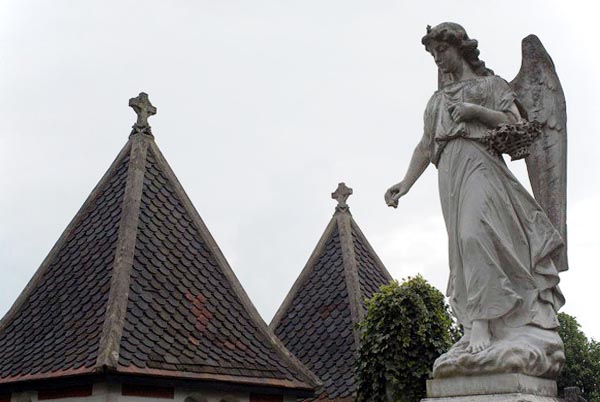
then on into englefield green with its two listed monuments in the
cemetery for the fitzroy somerset family, past a french chateau and
full-speed down prune hill worrying if my front wheel will take it. at
egham a heavy shower drove me to shelter under a tree in the
churchyard.
more pictures
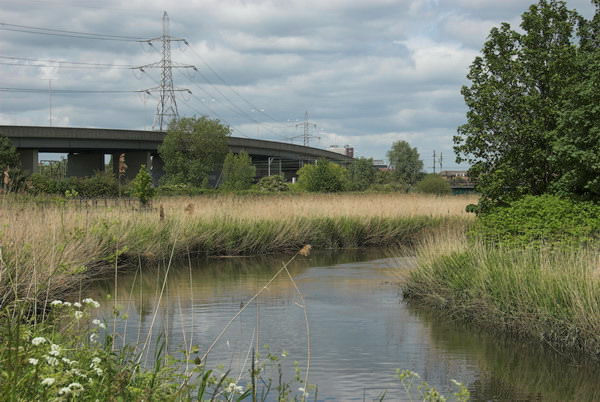
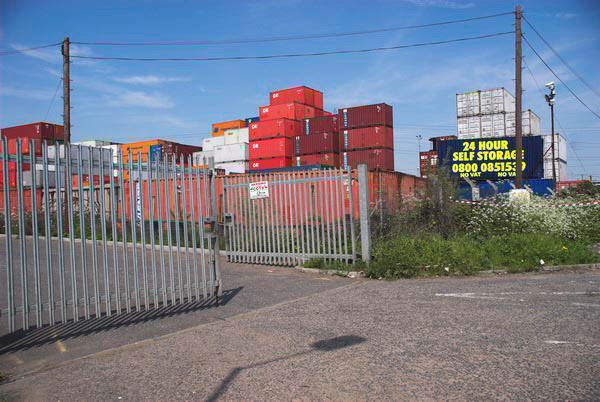
rainham is at the eastern edge of london, an area of marsh, industry,
warehouses, container stacks, dereliction and landfill on the essex
(north) bank of the thames, cut across by the elevated a13 trunk road
which sweeps across the creek and on over the marshes to purfleet,
along with the new channel tunnel rail link.
one day the thames path will continue past coldharbour point, but for
the moment its a dead end. i eat may sandwiches and then turn back,
making my way up onto the elevated roadway, but the views are
disappointing. at the next roundabout i take a look around and then
head north, past disused areas of the ford site and up through the
mardyke estate and south hornchurch. at elm park the heat of our first
hot day - 25 celsius in the shade, but i've been constantly in sun -
gets to me and i give up and take the underground towards home. the
heat has buckled some of the rails and the district line train has to
crawl along, more or less at my cycling speed, but at least i can just
sit and rest.
more pictures
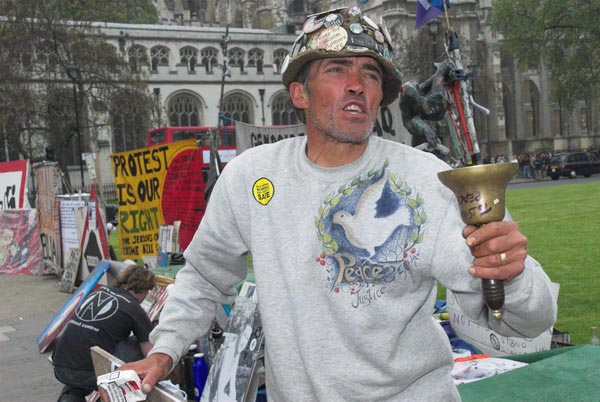
brian haw lost the appeal by the government over his protest in
parliament square, the court deciding that the serious organised
crimes and police act did apply to his protest after all, despite it
having started around 4 years before the act came into force. it seems
to be a decision that reflects more on the ability of the government
to apply pressure rather than one that suggests an independent
judiciary.
at the moment, brian is still there, his protest now regulated by the
police, but it seems rather likely that at some moment the feel
convenient they will decide to terminate it. on saturday morning i
went to have a short word with him and take some more pictures,
particularly of some of the bears who are with him. his protest from
the start has been about the killing of children, at first by the
effects of sanctions, then by the war, and the teddy bear symbolises
this (i think of one of the most poignant images from the second world
war, by cecil beaton, of a child in a hospital bed with a teddy bear.)
i hope to be back to see brian tomorrow, with a few friends. if he is
still there.
more pictures
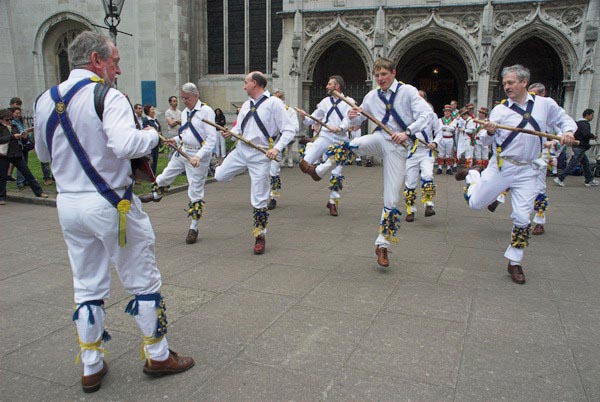
for several years there has been a dance festival in westminster in
may, with teams of morris dancers from around the country. i caught up
with them briefly dancing in front of st margaret's church next to
westminster abbey, then a little later in trafalgar square.
although i've never had a great desire to take up morris myself, it
certainly is one of our english traditions, going back at least 500
years - the first written record of it is in 1448. it was still alive
in many villages in the nineteenth century and a revival started in
the early twentieth century particularly through the work of cecil
sharp, who collected over 170 different dances around the country and
started the english folk dance society in 1911. sharp and mary neal
published books of dances, and in the 1920s and 30s, country dancing
became a part of most young school children's week. how i hated it in
the 1950s!
it is perhaps that enforced participation that led to morris dancing
being thought of as something false and lacking in credibility. in a
curious anomaly, our arts councils refused to support english ethnic
dances while (quite rightly) giving aid to foster dance and related
activities among minority ethnic groups. despite this, morris dancing
has continued to grow both in the uk and now increasingly abroad,
particularly in canada and the usa.
all the teams in trafalgar square were men, although there are also
many women dancers. one of the things that comes out in my pictures is
that the dance is at times a very athletic event. many of the
traditional dances use swords or staves and have a link to martial
arts. morris also has a strong link to another english tradition, the
ale house.
more pictures
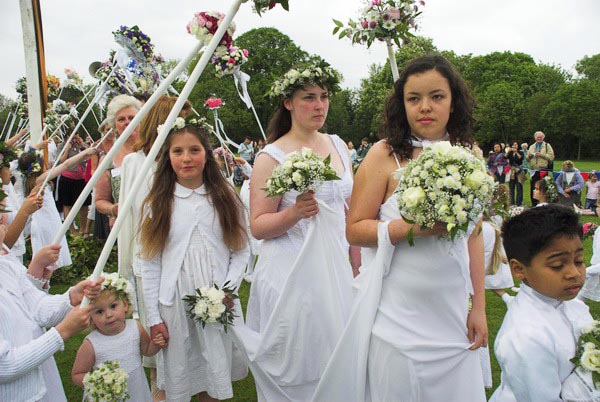
may continued for me with another may queen. last year i photographed
the oldest continuing may queen event at least in the london area, the
merrie england and london may queen fayre at hayes, kent, held
continuously since 1913. this year i went instead to brentham, where a
may fayre with maypole dancing was held in 1906, and its centenary was
held this year.
for this event, the organisers had managed to find and invite along
many former may queens, including some from the 1950s. some had come
long distances to be there, including one now living in america.
brentham was one of the earliest "garden village" estates, built by
'ealing tenants' a co-partnership housing scheme started in 1901 and
largely completed by 1915. the road layout was designed by raymond
unwin and barry parker, and it was in many ways a model for other and
better known garden villages.
the brentham may queen is less formalised that the south london
events, with little or no long speeches and ceremonies (unlike hayes
it was not set up by a dulwich schoolmaster.) as well as the may queen
elect and previous may queens, each with a small group of attendants,
there is also a herald who leads the parade (aided today by a brass
band) brittania, sailor and soldier, and, leading the large group of
around 150 young girls dressed in white with flowers, a jack in the
green, covered with leaves, with just bare legs and sandals visible.
after the parade around the area, there was a short ceremony in one
of the fields by the river brent in which last year's may queen
crowned the new queen, and a very short speech. following this were
country dances and dancing round the maypole, but i left before this
began.
more pictures
i've told the story of london's spitalfields many times before, how
it was built up in the early to mid-seventeenth century on the edge of
the city and was at first home to many non-conformist sects -
including the baptists. after the french protestant huguenots fled
france in 1685, many of the 40,000 or so who stayed in england ended
up there, setting up weaving lofts in the houses there (and it was
their taking refuge here that gave us the word refugee.) in 1743 the
huguenots built l'eglise neuve on the corner of fournier st and brick
lane. in the early 1800s it was briefly used by the london society for
promoting christianity among jews (who soon built a new chapel in
palestine place bethnal green.) around 1809 it became a methodist
chapel (most of the huguenots had either left or assimilated into
english life by then, becoming anglicans - or methodists), then with
the large jewish migration from eastern european pogroms became
spitalfields great synagogue (machzikey hadath or machzikei hadass) in
1897. particularly after the second world war, many of the jewish
population moved out into the suburbs, and were replaced by newer
immigrants, particularly from bangladesh, and the synagogue became the
london jamme masjid or great london mosque in 1976.
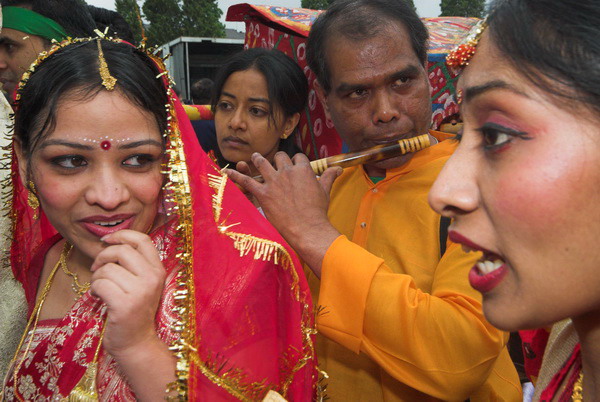
the first big baishakihi mela (bengali new year festival) in brick
lane was held eight years ago, and it is now billed as the largest
asian gathering in europe, with an expected attendance or 100,000 to
celebrate the coming of 1413. fortunately not too many of them had
arrived in time for the starting procession, which was surprisingly
small but colourful.
more pictures
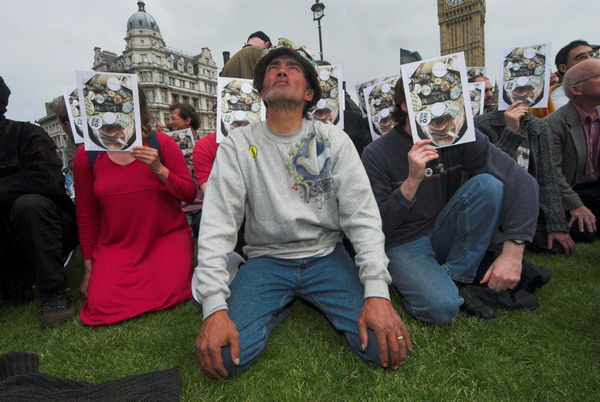
i went with it as it slowly walked down brick lane, but then rushed
on ahead to get the tube to westminster and parliament square to see
brian haw again. some of his supporters had decided to turn up and
show their support with a short demonstration.
the first thing i noticed on arriving in parliament square was the
almost total lack of police, with just a handful on duty at the gates
of the houses of parliament as always. of course the whole area is
live on tv at scotland yard, and our every move was doubtless
monitored real-time and recorded for possible later use. probably
their parabolic microphones also picked up some of my mutterings about
the idiot photographers who kept wanting the rest of us to get further
back. capa's "if your pictures aren't good enough, you're not close
enough" is generally my motto, although here it was more about being
in the right place to get the background that I wanted.
more pictures
since the victory of hamas in the palestinian elections, conditions
in palestine have deteriorated with the impostion of an economic
blocade by israel and the removal of support from the usa and the eu.
more than two-thirds of the people are below the poverty linel,
lacking basic necessities such as sugar, oil, milk, and even bread is
rationed. hundreds will die soon if vital medecines are not allowed
in.
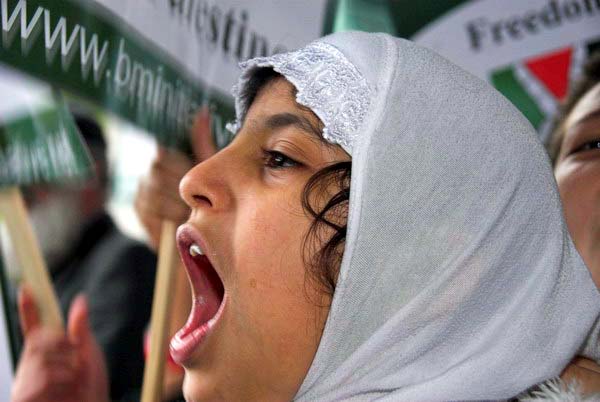
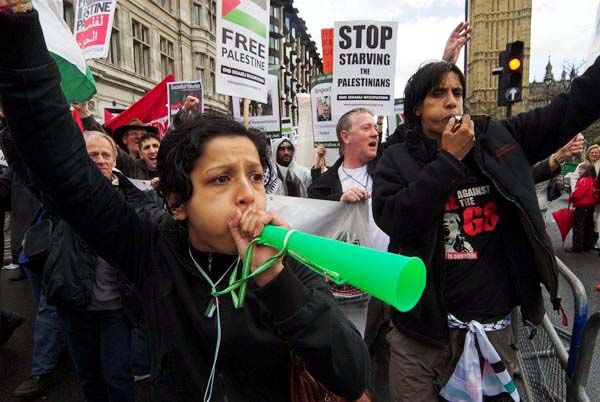
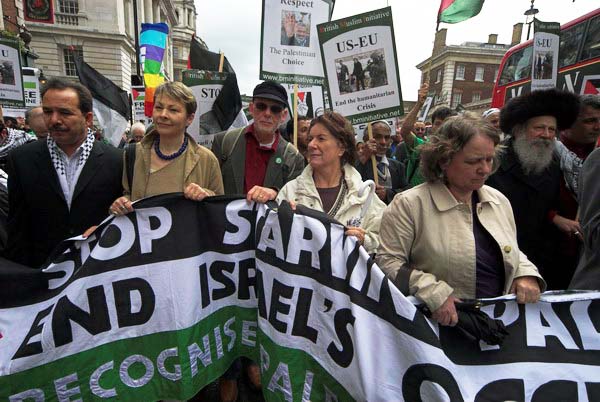
around twenty thousand demonstrators marched throught the streets of
london to a rally at trafalgar square where the main banner read "stop
starving palestinians, end israel's occupation and recognise
palestinian democracy. organised by the palestine solidarity campaign,
it was supported by many other organisations including peace groups,
the muslim association of britain and leading trade unions.
among those marching and speaking were green party mep caroline
lucas, labour mp jeremy corbyn, baroness jenny tonge of the lib dem
party and Manuel Hassassian, the palestine liberation organisation
representative to the uk (and appointed by the palestinian president
as ambassador but not recognised by the uk.)
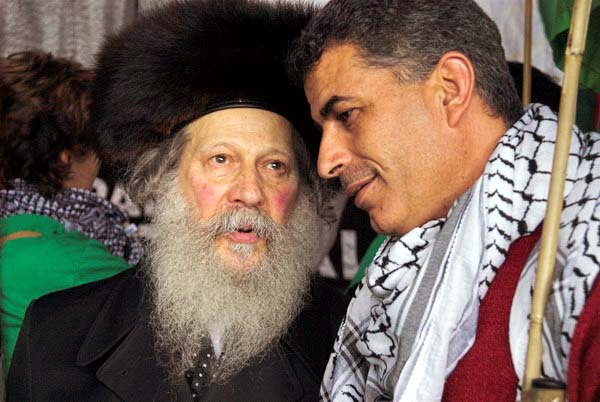
the neturei karta orthodox jews had walked from stamford hill on the
sabbath to attest to their support for palestinians and their
opposition to zionism. their stand has on occassion led to attacks and
threats by zionists, one of which i witnessed at an earlier event in
trafalgar square.
more pictures
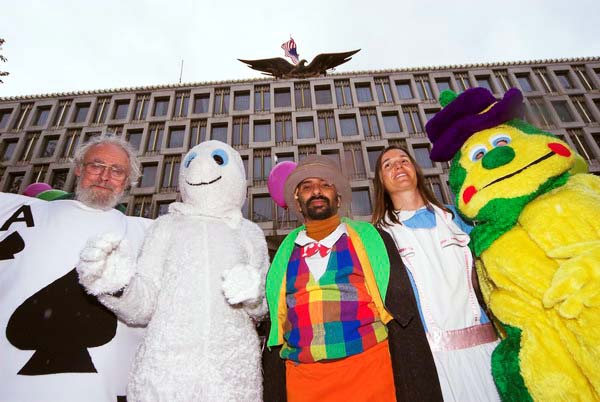
i left as the rally started to go to "bush in wonderland, a mad
emitters tea party" held outside the heavily barricaded front
of the us embassy in grosvenor square. the party was a part of an
ongoing series of protests including a weekly climate vigil outside
the embassy ongoing since the breakdown of the hague climate talks in
november 2000.
there was a picnic table with sandwiches, cakes and tea, music from
the eco warriors and guests with some appropriate lyrics, as well as
samba from rhythms of resistance, and fancy dress. balloons, banners
and a short speech by a white rabbit called phil reminded us of the
need for protests like these. the usa continues not only to pollute on
a massive scale, but increasingly acts to sabotage international
efforts to take any effective action on climate change.
the threat of a party there had led the police to close the gardens
in grosvenor square, though it was hard to understand what mayhem they
imagined rampant rabbits might cause.
it was a miserable and damp afternoon, cool despite global warming,
and some people didn't stay long, but others were still arriving when
I left, having come from the palestine rally in trafalgar square.
the campaing against climate change who organised this tea party (and
a whole series of weekly vigils and larger protests since 2001) is
organising a free climate conference at the london school of economics
with a wide range of speakers and workshops on saturday june 3, 2006.
they also have a march in london on saturday 4 nov, part of the
international day of climate protest before the nairobi un climate
talks.
more pictures
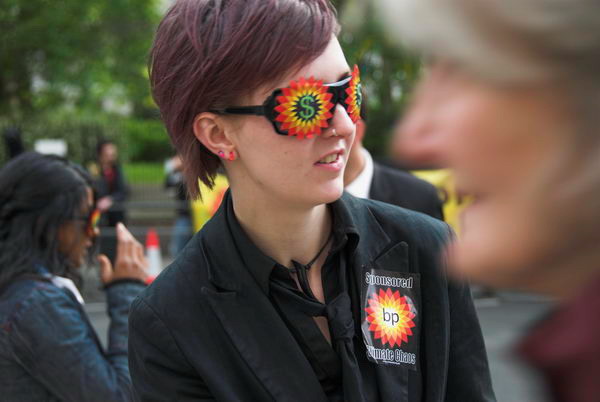
protestors demonstrated and handed out leaflets outside bp's st james
square london hq to mark the departure of the first tanker from the
ceyhan terminal on friday, may 26, 2006.
the btc pipeline has caused pollution along its route and an increase
in repression, disrupting many communities living around it. it has
helped to prop up authoritarianism in azerbaijan. as always it brings
wealth to some of those who are already rich, while it's the poor who
suffer.
as well as the increase in oil pollution, the pipeline is part of the
oil companies strategy to increase oil consumption and their profits,
creating greater carbon dioxide emissions and accelerating global
warming.
although some individual police officers were polite and helpful,
those in charge seemed determined to be awkward, both to demonstrators
and press, making it hard for the demonstrators to leaflet those
leaving the building. at one point i was asked to move from an almost
empty wide pavement where i was taking pictures into the road, which
carries intermittent bursts of often fast-moving traffic on the
ridiculous assertion that i was causing an obstruction.
more pictures
i'm expecting a knock on my door at 3am any day now, because some of
the pictures on my web site are apparently a grave risk to national
security. yes, it's brian haw's bears, part of the material that was
removed on security grounds from parliament square by around 50 police
officers in their raid early on tuesday morning.
also taken were the pictures of the children, demonstrating the
literally monstrous effects of the use of depleted uranium weaponry,
and much more of the posters and signs shown here and from other
occasions.
i'm actually very concerned about out national security and its
failures. our security services completely failed to spot the july 7
threat. why? largely because they had their eyes on the wrong balls,
for example giving serious credence to false information extracted
from suspects undergoing torture in libya and elsewhere, rather than
actually finding out what was really happening in the uk.
i'm worried now, in case they really think that brian haw's material
on display was a secuity threat. of course it wasn't, and everyone
knows it wasn't. it was removed because it was an embarrasment to our
government and our prime minister in particular. by concentrating
their attention on such embarrasments - rather than putting their
resources into the real threats, it is our security services that are
putting national security at risk. again they have their eyes on the
wrong balls. lying with blair doesn't make anyone safer.
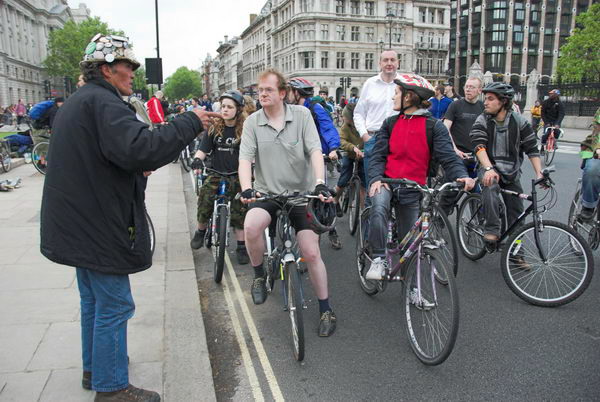
perhaps travelling by tube isn't such a good idea any more. critical
mass do it on bikes, and it was heartening to see a good turnout at
the end of may. the mass rode down to parliament square to give its
(belated) support to brian, who wasn't too amused. "where were you",
he asked, "when i needed you?"
it was perhaps a little unfair, because some of us had been there, if
not when we were actually needed, at least at times when we might have
been needed. and when the day came, by the time most of us heard the
news it was too late to get on our bikes.
at least brian is still there for the moment and his protest
continues. i hope it will continue to get our support, and critical
mass was there today to support him. it will help if more people go
and visit whenever they can - perhaps on their way to or from work, or
on sundays at noon.
more pictures
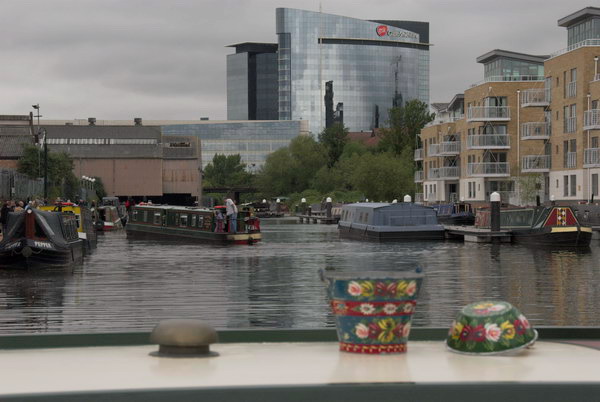
saturday I was defeated by the weather. It started bright, and I had
a usual list of events and places to visit. brentford is on my way
into london, so I stopped off there for a quick visit to the waterside
festival there. i find it depressing, with so many flats having been
built in what was, even in the days when the canal was busy, a
relatively empty area. and the simplicity of the sheds has been
replaced by busy, fussy buildings.
at least it was good to be able to walk across over the lock bridge,
always out of bounds to the public. you can walk around the island
too. there was a small history exhibition in the toll house at the
lock, and free boat trips i couldn't be bothered to queue for, but
most of the festival could have been anywhere. i was soon ready to
leave, wandering back to the station through the butts, still a
surprisingly quiet and elegant street.
more pictures
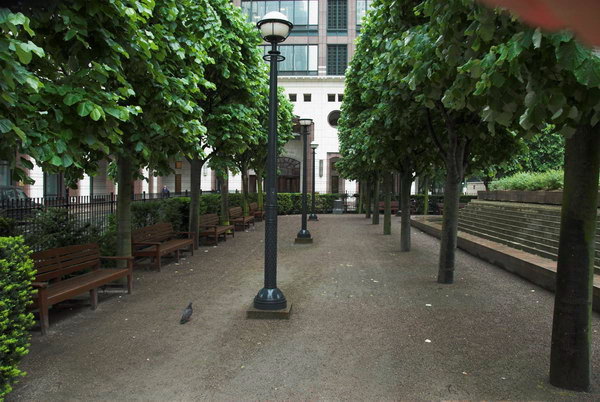
my next stop was canary wharf, but by the time i got there it was
raining steadily. much of it was taken over by car companies who had
scattered vehicles - mostly expensive and ecological disasters -
around the place. there was a silly course you could drive a land
rover around too.
i walked around a bit in the rain, then decided it was time to
abandon ship and go home.
more pictures
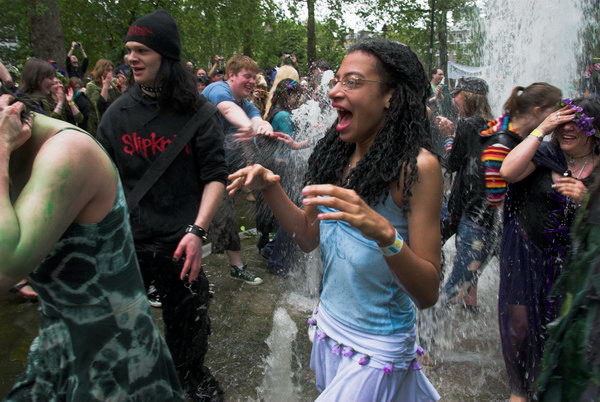
the pagan pride parade in holborn is now a regular annual event, a
part of the beltane bash that takes place in the conway hall in red
lion square. mostly it was the same people as last year, but i found
it hard to get into the mood to take pictures.
as usual the parade was led by jack in the green - a dancing bush -
the green lady and the bogies. the giants included the morrigan (in
green and flowers to welcome summer) with black ravens, old man
thunder and old dame holder, along with the rest of it.
dancing round the fountains was energetic, but somehow for me the
event didn't really get going, and lacked any real climax, people just
slowly began to fade away.
more pictures
i went on to east ham, hoping to see the end of the chariot
procession, but i was really too late. i should have gone out earlier
so i could photograph this first. i took a few pictures of the
chariots, then went to walk along by the river roding and to
photograph a new development by the railway in barking. tanner street
does look quite interesting.
more pictures
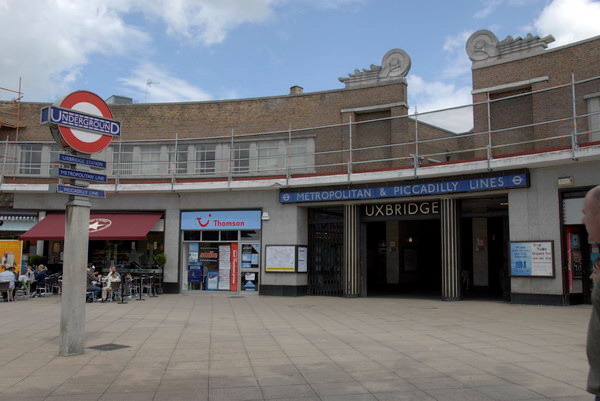
living on the outskirts it is easy not to realise how much bus
services in london have improved. taking the train to feltham and then
two buses we got to uxbridge in just over an hour. of course, cycling
would have been quicker. but from uxbridge we were walking the london
loop, an almost unsigned footpath route.
most of it was pretty boring, far too much green. the book giving the
route is pretty hopeless in places too, which is perhaps why there
were parts of it that very few people seem to have found, with badly
overgrown paths. we ended up at moor park, which seems to be one of
the most depressing parts of london, large (and very expensive) bad
houses, mainly from the 1950s and later in the part we came through.
taste and money don't seem to go together.
coming shortly
 At the Temple door